Start with one sound
Resist the urge to record "the garden". Instead, pick one sound and describe it in a sentence: "water dripping from the end of the shed gutter onto an upturned flowerpot." That sentence tells you where to stand, how close to get and how long to wait. It also gives your future self a useful label when you are scrolling through dozens of files called ZOOM0047.
The wildlife recordist Chris Watson often talks about letting a place reveal itself over time. You can borrow that approach at home: set the recorder down, step away, and let ten minutes run. The best moments often arrive after you have stopped fidgeting.
Gear you already have
A modern phone is a perfectly good starting microphone, especially with a free recording app that saves uncompressed files. If you want to upgrade later, compact handheld recorders such as the Zoom H1n or Tascam DR-05X are popular because they have decent built-in microphones and physical gain controls. Headphones matter more than people expect: any closed-back pair will let you hear hiss and wind that a phone speaker hides.
Settings, explained plainly
- File format — WAV. WAV keeps every detail. MP3 throws some away to save space, which becomes obvious once you start stretching and layering sounds.
- Sample rate — 48 kHz. This is how many snapshots of the sound are taken each second. 48,000 is the common standard for video and music work and is plenty for garden material.
- Bit depth — 24-bit. This controls how finely loudness is measured. 24-bit gives you more room before quiet sounds sink into hiss.
- Gain — set by ear and meter. Gain is the recorder's input volume. Aim for the loudest moments to peak somewhere around −12 dBFS on the meter, so a sudden crow call does not distort ("clip").
Example starting settings — adjust to your recorder
Placement and distance
Distance is your main tone control. Close up (a hand's width away), a dripping leaf sounds big, dry and detailed. Two metres away, it gains the garden around it. Try both and keep both — close takes make good percussion; distant takes make good ambience. Put the recorder on a small tripod, a fence post or a folded towel rather than holding it, because hands create rustle and handling bumps.
Wind and weather
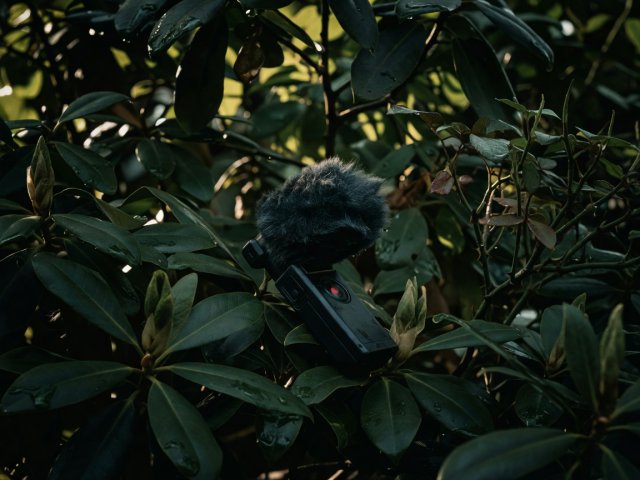
Wind is the most common reason garden recordings fail. Even a light breeze hitting a bare microphone causes low, booming thumps. Use a foam windscreen at minimum and a furry cover (often nicknamed a "dead cat") outdoors. Shelter the recorder on the downwind side of a hedge, wall or shed. For rain, a recorder under an overhang or inside a clear food bag (with the microphone end exposed but sheltered) keeps water off while letting sound through.
Recording birds without disturbance
Birds come first, recordings second. In the UK, nesting birds are protected under the Wildlife and Countryside Act 1981, and many other countries have similar laws. Keep your distance from nests, do not trim vegetation to get a clearer line, and do not play recorded calls to attract birds — it can stress territorial males during breeding. The dawn chorus, which peaks in spring, is the easiest time to record a rich mix from your doorstep. International Dawn Chorus Day, held on the first Sunday of May, is a good excuse to try.
To identify what you captured, reference libraries such as xeno-canto, the Cornell Lab's Macaulay Library and the British Library's wildlife sound collection are invaluable listening resources.
Room tone and notes
At every spot, record ten seconds of "nothing" — just the background air. Editors call this room tone. Later it fills gaps when you cut out an unwanted noise, so the edit does not drop into unnatural silence. Then speak a quick note into the recorder or jot it down: time, weather, what you were aiming at. Sound recordist Gordon Hempton, known for his One Square Inch of Silence project, has shown how rare truly quiet places have become, so log the noise you could not avoid too — planes, mowers, roads. It helps you plan better sessions.
Neighbours and privacy
Gardens are shared acoustic spaces. If you catch an identifiable conversation over the fence, delete it or make sure it is unintelligible before you share anything. Let neighbours know what the small device on the fence post is; most people are curious rather than bothered.