Found percussion in the garden
Walk the garden and tap, shake and scrape things gently. You are listening for three families of sound:
- Shakers: dried poppy heads, honesty pods, love-in-a-mist seed capsules and a handful of gravel in a jar all rattle. Each one has its own grain.
- Drums: terracotta pots of different sizes give surprisingly clear pitched tones when tapped on the rim; an upturned plastic tub or a water butt gives a low thud.
- Clicks and sticks: bamboo canes knocked together, a trowel on a stone, a snapped twig. These are your sharp, short accents.
Rain and dripping water are found percussion too. A gutter dripping into a bucket can produce a surprisingly steady beat, especially in the minutes after a shower ends.
Hand drums worth knowing
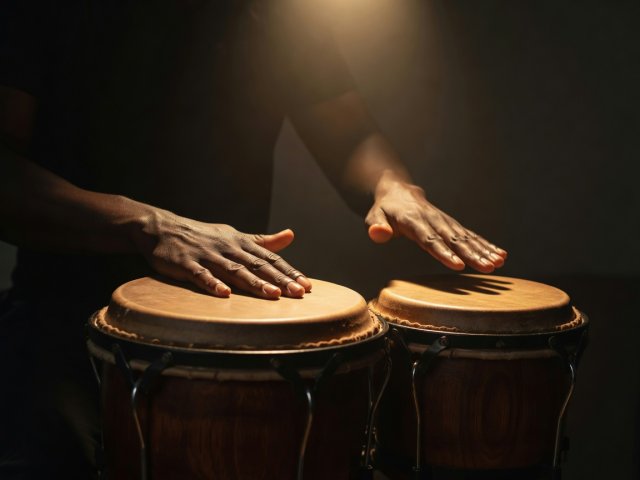
If you want a "real" instrument alongside your found sounds, a hand drum is the friendliest choice. Bongos — the pair of small joined drums from Cuban music — give bright, high tones that sit nicely above garden ambience. The cajón, a box drum from Peru that you sit on, offers a deep bass hit and a snappy top in one instrument. A frame drum is light, quiet and very expressive, while a djembe from West Africa has a powerful bass and sharp slaps. Each of these can be played softly enough to blend with birdsong rather than drown it.
Tempo and loop maths
Tempo is measured in beats per minute (BPM). A bar in common time contains four beats. To find how long one bar lasts, divide 60 by the BPM and multiply by four. At 90 BPM, one beat is 0.667 seconds and a bar is about 2.67 seconds, so a four-bar loop lasts roughly 10.67 seconds. Knowing this helps you cut a recording to exactly the right length so it repeats smoothly.
Example loop maths — 90 BPM, four beats per bar
Finding a pulse in natural sound
Natural sounds are rarely perfectly regular, and that is their charm. Play a drip recording and tap along. If your taps settle into a steady rate, measure it with a free tap-tempo tool or count taps over fifteen seconds and multiply by four. Set your project to that tempo and the natural sound will feel "in time" without being forced. If the sound drifts too much, slice out the individual hits and place them on the beat grid by hand.
Quantised or human?
Quantising snaps every hit exactly onto the grid. It sounds tidy but can feel mechanical next to living sounds. Many producers quantise only partly — say 50–70% — so hits move towards the beat without losing their wobble. Swing is another tool: it delays every second subdivision slightly, giving a lilting, rolling feel that suits rustling, shuffling textures.
Rhythm experiments to try
- Phase play. Steve Reich's Clapping Music (1972) uses two performers clapping the same pattern while one shifts by a beat at a time. Try it with two identical seed-pod loops, nudging one slightly later each pass.
- Three against two. Loop a pot tapped three times per bar against a frame drum hit twice per bar. This polyrhythm — two patterns sharing a time span — creates gentle tension that natural ambience softens beautifully.
- Silence as an instrument. Take any loop and mute one beat in four. Notice how the gap draws your ear to the birds behind it.
Recording percussion cleanly
Percussion has sharp transients — the very first instant of a hit — and those are what usually cause distortion. Lower the gain further than you would for birds, and place the recorder about 30–50 cm from the source. Record each found instrument separately, several hits in a row, so you have choices when building your loop. Keep a few "bad" takes too; a wobbly shaker sometimes becomes the most interesting layer.